Thursday, June 25, 2026

"You May Delay But Time Will Not" Benjamin Franklin

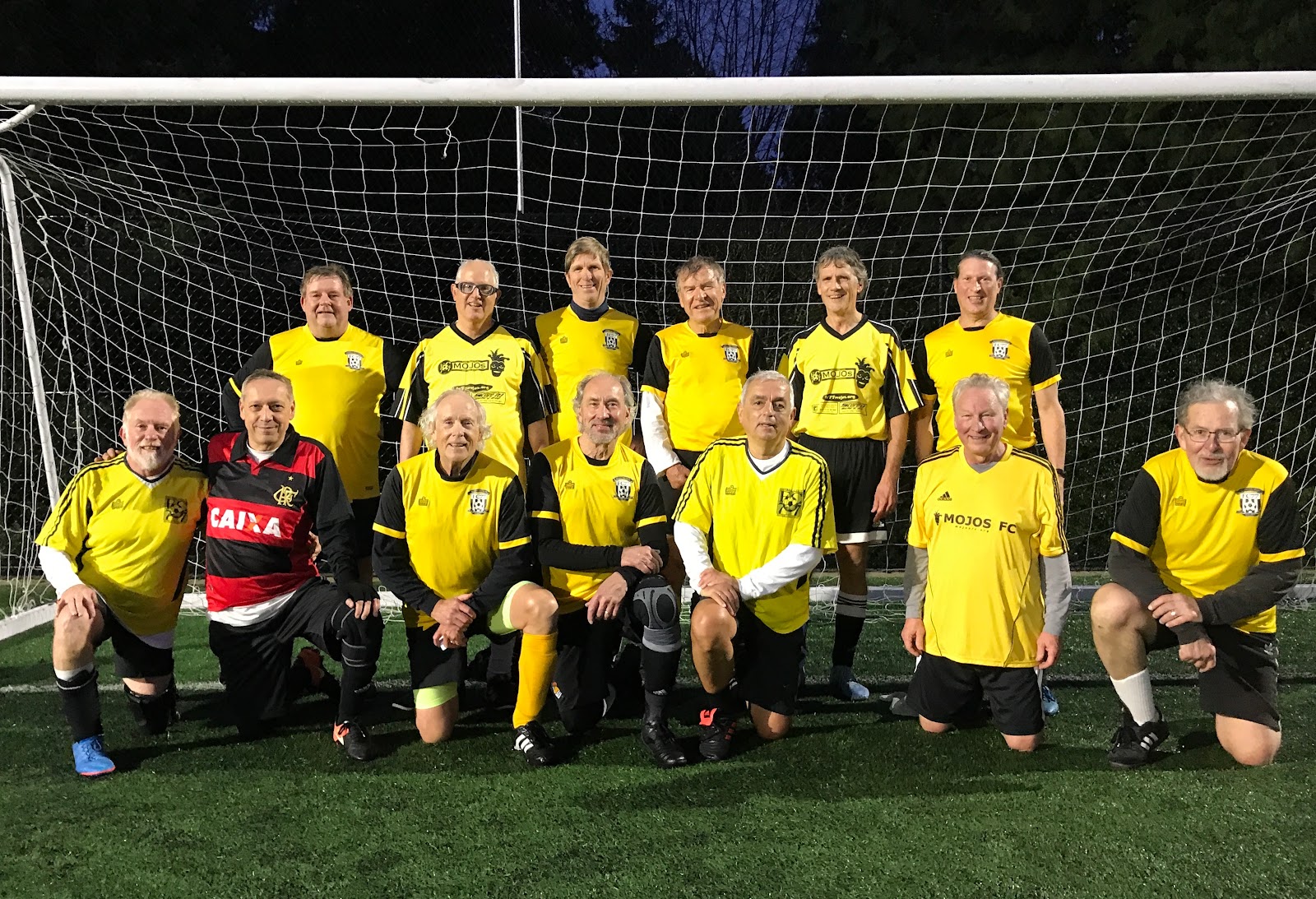
FC77 Older Nicks Spring 2026
In the mid-July summer of 2010 I thought that I should try writing a blog which I understood to be an online form of essaying.  I also thought that I would focus my writing on my experience as a soccer fan and amateur soccer player.  In the mid 70s when I was first introduced to 'the game' via the arrival of the the NASL Portland Timbers in our town,  I was working as a freelance writer on local sports and culture topics.  I managed to convince Lou Gauthier,  publisher and editor of Soccer Corner to offer me press credentials,  soccer story assignments and small amounts of money for each article he published.  The press credentials were a big incentive.  With my paper 'game pass' strung round my neck,  I could venture into the vast dark caverns below the Civic Stadium stands to ask questions in the team dressing rooms.  And could also climb the narrow stair to the high press box suspended under the west grandstand roof. Refreshments were provided which was a welcome perk.  And I was included in the game discussions with "real journalists" like The Big O's John Polis.  And press from opposing town papers or even occasional Sports Illustrated level scribblers.  The press credentials covered me to interview opposing clubs, college coaches and interesting folk in the broader soccer world.  My favorite interview back then was an hour or so spent with Robbie Rensenbrink, one of the stars of the "clockwork orange" Dutch national team in 1974.  He was a  very gracious and pragmatic interviewee.  He recognized that his knees were not going to last long and he was grateful to be in Portland with the opportunity to play.   
 
In the summer of 1977,  I was so taken with the game that I turned out for a 'recreational' league with scores of other men.  A core group of us enjoyed the summer experience so much that we stayed together as a team for the fall men's league.  I was not naturally athletic, but I was enthusiastic and enjoyed being on the team.  By 2010 I had been playing soccer for more than 30 years with team mates who had become staunch friends.  My social life was deeply entangled with my soccer life.  I remember reflecting with surprise that I was a 60 year old soccer junkie--still playing in league games on my Old Nicks team and kicking the ball around at weekly practices, euphemism for an hour of pickup play followed by an hour or so of beer drinking, reminiscing and tale telling.  
 
We are now passing through June 2026. I came home at noon today from a 'kickaround' at a cross town field with fourteen other older adults. Several of them are players I've teamed up with or played against since those early soccer days. Three of them were women, also in my age group, who've played for as many decades as I have. In Portland there are at least three of these 'old guys' sessions each week. It's not unusual for enough players to show up that we have three games of 10 v 10 played with small goals and no keepers. In this past year, we began an 'unofficial' O70 division. The fields are about 3/4 full size, 9 players on the field, 40 minute halves. Rules formulated through a democratic process to limit physical play and the risk of injury. The division generally follows the pattern of the formal soccer district--spring season of ten games and fall season of ten games.

I marveling that I am 76 years old and still playing.  And still playing in the company of my peers, though some of them are no longer with us.  I was taken by the Benjamin Franklin quote.  I am deeply grateful that I did not delay to make my life reflective of things I believe are important.  An active life and strong friendships are gifts.  I don't know when I'll 'hang up my cleats' but I am not waiting for it to happen.  

Monday, March 9, 2026

Mike Calder- 1953-2026

I met Mike Calder in June of 1977.  A hundred or more adults gathered at Delta Park one weekend to find out about playing summer recreational soccer. Portland Parks & Rec sponsored the event at the urging of Marijan Bosnar.   It was aimed at people who had not played the game before but who’d maybe seen the NASL Timbers. Or watched Soccer Made in Germany on PBS. 

The gathered adults were split into two large groups. A dozen balls were thrown out.  And we were encouraged to “play”which meant mostly "kick and run".  Afterward,  people interested in joining newly forming teams were directed to gather at one of several “stations” where team sponsors would sign us up.
Mike and I and about a dozen other guys including Mark Dillon ended up in a group sponsored by Glenn O’Dell, partner in an engineering firm—Seton, Johnson & O Dell.  None of us had met before.  I am not sure anyone had played on a soccer team before.  My 'experience' was 'bounce passing and trapping' on a nearby basketball court.


We named the team SJO Irregulars. The title was inspired by our jerseys--orange and yellow polo shirts from the Jantzen sportswear 'irregulars' table.  I have no clear memories of that summer’s games.  But the experience was good enough that we decided we should sign up in the fall Portland Men’s League. 

We never looked back.  O’Dell left for Seattle,  and we became Stouthearts for Schwabe  attorney Bob Stout, our goalkeeper.  I recruited my brother Brian Porter.  He recruited his friend Pat McKernan. New players arrived and others left. Bob Stout moved to Eugene in the early 80s. We practiced Wednesday nights under the lights of the adjacent tennis court at Colonel Sumner Park. Rain or shine.  We finished our evenings at Don Younger's Horse Brass Pub nearby. 

Mike picked up the sponsor search and took the team's reins.  He convinced the local representative for Young’s Brewery in England to sponsor us.  Our patronage at the Horse Brass helped.  We played in jerseys with the logos of Newcastle, Rams Head, Old Nicks, Tiger Beer and Young's Pale Ale.  Mike and Doug Morasch became key figures in the team mechanics.

By the mid-80s the team became two teams.  For the most part we played as Old Nicks and Newcastle.  Mike and Doug were team managers.  Notable players included Alex Addy, Dominic Yambasu, who coached us to a championship and a growing international cast of characters.  What an eye-opening experience!  Mike was at the helm of the group

Our core group shared a common attraction to the European club model.  Teams that were anchored by having a family friendly component,  a field of their own and a clubhouse.  I had experienced that model of soccer in Munich in '76.  As we entered 1997 still playing together, desire for a more substantial structure became intense.  We conceived of creating a non-profit club which would be the umbrella organization for individual teams.  By fall of that year FC77, our football club, became a reality.  We hosted a summer Athletic Cup picnic and kickaround for families and current and past players.  Mike used his graphic design skills and designed a black and white logo. I purchased a s
upply of t-shirts, sweats, hats and other items with the new logo to sell and strengthen our sense of identity.  Five teams were now affiliated with the club through several divisions.  Mike Calder was the president.   

In 2007, I stopped in the office at Montessori Earth School to ask about using their sport field for some of our soccer matches.  The talks led to FC77 and the school agreeing that the club teams would play all their home games on the grass soccer field on SE 148th.  The annual Athletic Cup would be held there.  The club would receive per game field fees from the GPSD which they would pay over to Montessori.   For a short time it appeared to be an ideal agreement.  Hosting more than fifty matches on the grass field, particularly during wet springs,  degraded the field condition and the school decided that the agreement was not workable as a result.  

At the beginning of the Millenium, Old Nicks signed up for a new adventure.  On the MLK holiday each year,  a tournament named for Dr. King was held in Las Vegas.   The tournament was an entertaining adventure.  The Nicks weren't competitive in a mix that included former NASL players and ethnic select teams.  But over the next years,  they selected stronger teams,  traveled and won more often.  In 2005 not enough Nicks players were able to go.  Team member Lyle McBride asked players from other teams in the league if they were interested.  A squad from Masterbooters, Old Nicks and Jimmy O's Pizza went and they played under the acronym FC77 MOJOs employing the first letters of the three team names.   

FC Mojos became a separate tournament soccer club. An FC77 anchor, Glenn Fithian Barrett's Bier Wagen, became a club institution. The Athletic Cup became a family event. And new competitions like the tournament in La Paz began. 

Mike Calder was a central figure in all of these evolutions.  He managed the Newcastle team for years.  He was always reliable; if he said he'd do something he did it. He was noted for believing that camaraderie was more important than winning.  While he often found situations frustrating I can't remember a time he got angry--often talking players into setting aside differences.  He was passionate about making it possible for people to play. To that end he helped form teams for players who didn't have one. Miscellaneous United and Random assortment were his humorous names for two of them. The key was persuading someone to be the manager with Mike's help.   

On the field he was respected as a solid defender and also was the 'go to' goalie when teams needed one. He was also trainer and medic for team mates.  I remember he was an advocate of DMSO as a liniment for healing injuries. You'd rub it on your knee and immediately experience garlic taste in your mouth.  He was a proponent of CBD in more recent times.  And I believe he was recommending drinking a mustard potion at a tournament last summer.  

Mike was generous with his time and skills off the field as well.  He volunteered on the GPSD board and elsewhere.  He always helped out at events and was active in club governance.  He was an "uncle" to kids his sister Karen fostered.  He had a wicked sense of humor and collaborated with Mark Dillon creating funny copy for the FC77 website and Newk News an occasional newsletter.  He would include terrible puns at the end of his match reports.  When the Athletic Cup was launched he found a base from an old trophy and glued an actual 'athletic cup' to the top, spray painting it gold.  

Mike was a writer.  He was working on a science fiction novel about the NFL and organized crime.  He was a talented artist traveling to Asia on projects to create faux images for hotels and similar buildings.  He applied his graphic design skills to create the original FC77 logo.  When the club held a contest for a new logo in our 40th year,  Mike updated his orginal logo design and added the logo "We Play Till We Die" in Latin script.  Little did we imagine how literal that might be.  He was on the O70 field playing just before the holidays.  As 2025 ended he contracted an infection which took his life on January 13, 2026.

For almost fifty years of being his friend and team mate, he gave me opportunities to keep playing the game and to emulate his style of being an admirable human.  


Tuesday, March 15, 2022


 In mid-February, I received email from the staff at Oregon Adult Soccer Association.  Anne Braghero, a longtime friend and soccer player, let me know that a woman had left materials she had found in her uncle Eric Nelson's effects while cleaning out his house after his passing.  Becca, the OASA Office Manager, had talked with her and had agreed to take them.  The photos and paper documents were brief snapshots from the Vikings soccer team which had played in the Portland Soccer League beginning in the 1920s. 

I was very excited to see this material. I knew of the team from the Cameron Cup championship lists and news clippings, but I had never seen anything with more detail.  The photo above is a team photo, likely from 1928.  The woman's uncle, Eric Nelson, is standing, second from left. I am struck by the very makeshift appearance of the goal around them.  Also notable is that some of the players have a beverage in hand--some things don't change.  And I wonder if the small item on the ground on the right might be a trophy?  Or just another bottle.  

Another item was a hand drawn 'game program' from Sunday October 7, 1928.  It is entitled Jays Soccer Sheet and pictures  a Viking facing a Scotsman on the cover with "Welcome Vikings" as a title and a subscript reading "worthy foemen".  The Longview Lumber Barons were hosting the Vikings side.

Players and positions on the roster sheet to the left also include captions and comments from the writer.  Two hand drawn ads-one from a jeweler and one from a plumber adorn the inside cover.  The flavor with which it is done reminds me very much of the 'home made' character of my early years in the Portland soccer league.  

Also included in the materials were several Viking Soccer Club membership cards for the year 1929 signed by president Arthur Harold.  I note that his name doesn't appear on the player roster nor are there substitutes listed.  The  Timber Barons were the Cameron Cup winners from the 1925-26 season until the 1928-29 season when they were bested by the German Sport Club for a year.  The Vikings came back to take the cup in 1931-32.  They made their last appearance as Cup winners in 1955-56.

The "season" for the Portland Soccer League appears to have been the one we started with in the late 70s.  September - March with a break over the holidays. Of course, all games were played on grass fields which had little grass by the end of the season. Other notable teams during these years included the Camerons (Judge Cameron's select side), Sellwood ( for whom Hugh Templeton played), Germania, Clan Macleay, Peninsula, National FC, Pacific Dept Store, Portland Scottish.   There were also Rosebuds who may have hailed from Olympia and White Heathers.   

I began to look for material documenting the period of soccer in Portland before the '75 Timbers somewhere back in the 80s.  As a history fan I was sure the game must have been played.  Thus these materials on Eric Nelson and Vikings. 


Monday, March 14, 2022

Silent No More

I have been happily busy for the past few years with playing soccer myself,  working at Leach Botanical Garden, a job I am privileged to have and enjoy, and practicing the art of being a Grampa. Along with many other activities. 

Recently, however, I was contacted by the Oregon Adult Soccer Association staff to let me know that a woman had dropped off ephemeral artifacts from the Vikings Soccer Club which had been active in the sport since the 1920s, a hundred years ago. I was also contacted in regard to the transfer of the Cameron and Bennett trophies to the Oregon Historical Society by the family of Roger Hamilton, a longtime champion of the sport. These two legendary cups in Portland's soccer history had turned up through Roger's efforts in 2010.  I was privileged at the time to meet with him as he had them examined for authenticity by an expert. 

These two events reminded me that the historical part of the game deserves documentation as we march further into the era of MLS and the Portland Timbers.  I dusted off my log-in file and resolved to get back to posting about that distant past.   Excellent and knowledgeable writers are already covering the sport at the professional level and the game is thriving as participation grows in weekly pickup games by the dozen around the city.  (I am a participant in "kickarounds" each week which draw between twenty and forty players most of whom are over the age of 60. 

So here it is--a rejuvenated Sodden Pitch, a virtual square of white space upon which I can write anything I desire.  I promise to stay on topic and hope to provide interest and value for those who believe that institutions need roots and traditions and talismans.  

FC77 Older Nicks - O65 Division 2021